Ceramic jar for extra virgin olive oil: history, tradition, and why it remains one of the best containers for EVO oil today
The ceramic jar is one of the most authentic symbols of Mediterranean culture. For centuries, it has held a precious food like extra virgin olive oil, protecting it from light and accompanying the history of families, oil mills, and artisans who have passed down ancient knowledge to the present day.
Today, despite the arrival of glass bottles and stainless steel containers, the jar continues to represent a prestigious choice. It is not just an elegant container, but an object that embodies tradition, craftsmanship, territory, and quality. In fact, more and more people are choosing a ceramic jar not only to store EVO oil, but also as a piece of furniture, a gift idea, or a personalized favor.
For us at Contedoro, every jar tells a story. That of our olives grown in Irpinia, the production of our extra virgin olive oil, and the collaboration with Italian artisans who transform clay into authentic works of art.
When quality oil meets a handmade artifact, something unique is born: a product that represents the best of Made in Italy.
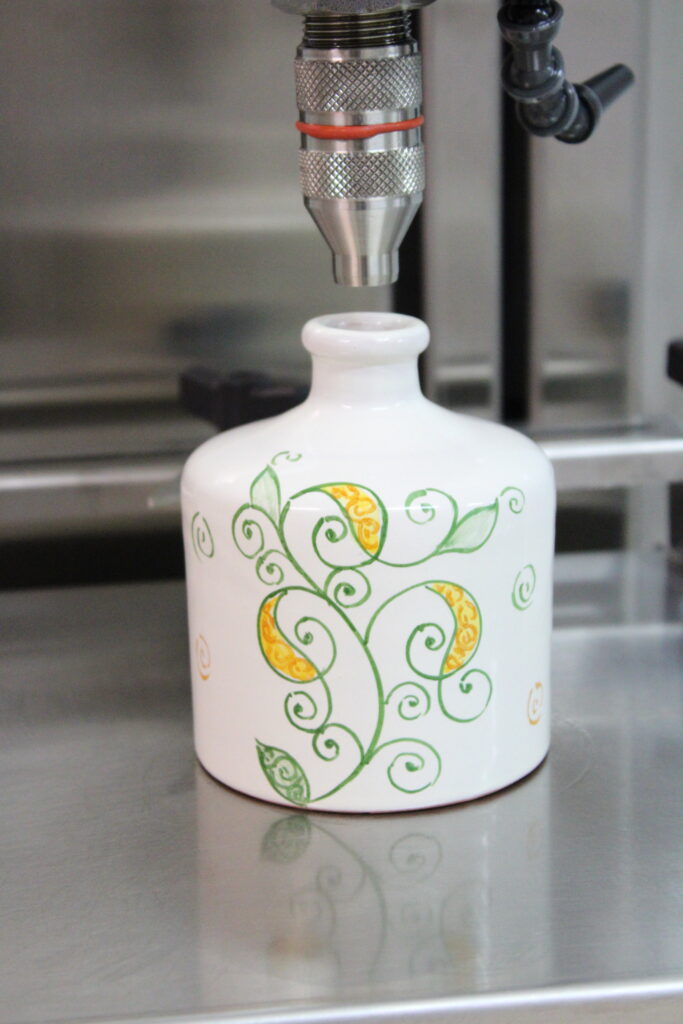
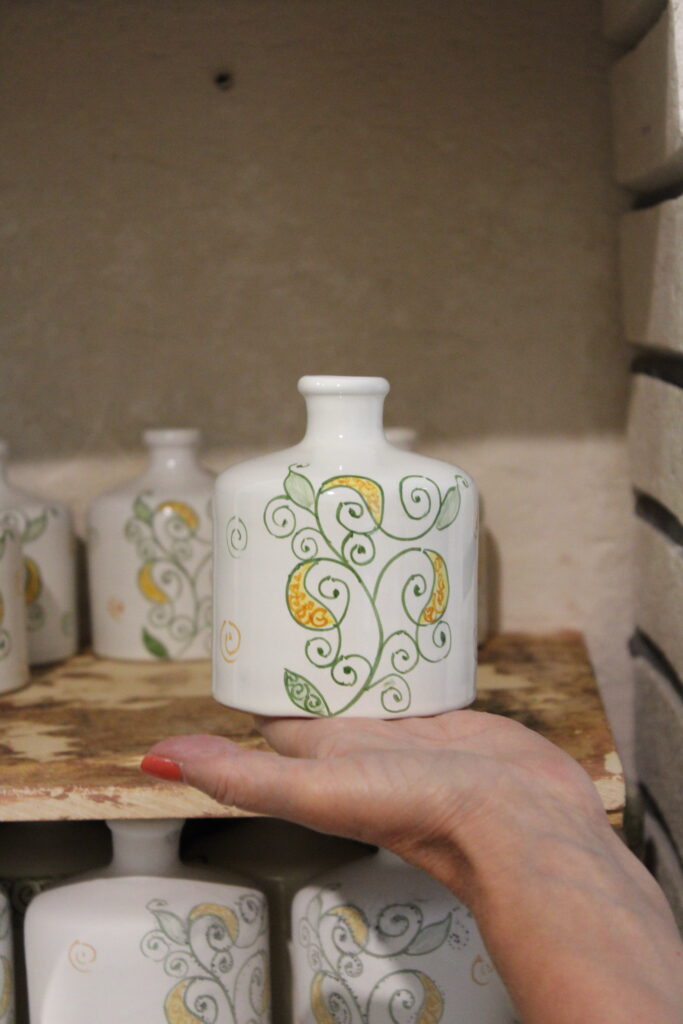
Contedoro artisanal ceramic jar with organic extra virgin olive oil.
In this guide you will discover:
the history of the ceramic jar;
why it still represents one of the best containers for EVO oil today;
the differences between terracotta, ceramics, and majolica;
how jars can be transformed into elegant gift ideas and favors.
The ceramic jar: a history thousands of years long
The jar is not a simple modern invention. Its history is rooted in the great civilizations of the Mediterranean, where olive oil represented a resource as precious as wine and grain.
Egyptians, Phoenicians, and Greeks were already using large clay vessels to transport and store oil, wine, and cereals. Later, it was the Romans who perfected their production, creating containers that were increasingly resistant and suitable for long-term food preservation.
Clay was easily available, resistant, and workable. Once fired, it allowed for robust and durable vessels, ideal for holding high-value foods.
For centuries, every peasant family owned at least one large jar intended for new oil. It was not just a container, but a precious object that was often passed down along with the family’s olive groves and lands.
Even today, visiting ancient Italian oil mills, it is possible to find large jars used for oil storage, concrete testimony to a tradition that continues to live on.
Why ceramics specifically?
Anyone who produces quality extra virgin olive oil knows well that preservation is as fundamental as the olive harvest and extraction.
Even the best oil can lose some of its characteristics if stored incorrectly.
Thanks to its opaque and compact structure, it helps to naturally shield light, creating favorable conditions for oil preservation. For this reason, many producers still choose ceramic bottles and jars for their premium lines.
Naturally, in addition to the container, it is important to store the oil in a cool, dry place away from heat sources.
If you want to learn more about how a quality oil is born, you can read the page dedicated to our extra virgin olive oil.
Terracotta, ceramics, or majolica? The differences
Very often these terms are used as synonyms, but in reality, they indicate different processes.
Knowing these differences also allows one to understand the value of an authentic artisanal jar.
Terracotta
Terracotta is born from the simple firing of clay.
Its typical color, which varies from red to ochre, depends on the natural composition of the earths used.
For centuries, it was the main material used in the production of jars, amphorae, and vessels intended for food preservation.
Even today, it represents the base of many Italian artisanal productions.
Ceramics
The term ceramics identifies a very broad family of artifacts obtained from the processing of clay and subsequently fired at high temperatures.
Subsequently, the artifact can be finished with protective coatings that improve:
impermeability;
resistance;
durability;
aesthetics.
These characteristics make ceramics particularly suitable for food containers as well.
Majolica
Majolica represents one of the most precious forms of Italian ceramics.
After the first firing, the artifact is covered with a white glaze on which artisans hand-paint decorations inspired by Mediterranean tradition.
Olive leaves, floral motifs, and classic decorations transform each piece into a unique work.
A second firing permanently fixes the colors and glaze, providing brilliance, depth, and resistance.
Campanian ceramics: an excellence of Made in Italy
When speaking of Italian ceramics, one often thinks of Vietri sul Mare, Deruta, or Caltagirone.
However, there is another important artisanal tradition, less known but rich in history: that of Ariano Irpino, in the heart of Campania.
For centuries, this territory has safeguarded a heritage made of experience, manual skill, and knowledge of materials.
Every workshop passes down ancient techniques that require patience, precision, and artistic sensitivity.
The true difference between industrial production and an artisanal artifact is not only noticed by observing the decorations.
It is perceived in the small imperfections, in the depth of the glaze, in the slight differences between one piece and another.
It is precisely these details that make every jar unrepeatable.
For this reason, every artisanal jar tells a different story and becomes an object destined to last over time.
Why Contedoro chose ceramic jars
For us at Contedoro, the jar does not simply represent elegant packaging.
It is the natural completion of the journey that brings the oil from the olive groves to the table.
Our olives are grown with care in the Irpinia territory and transformed into an organic extra virgin oil that tells the character of our land.
We chose to safeguard it in artisanal jars because we believe that a quality product deserves a container capable of telling its story.
Every jar holds two Italian excellences:
the work of the olive grower;
the mastery of the ceramicist.
It is the meeting between agriculture and craftsmanship.
How an artisanal ceramic jar is born: from the earth to a work of art
Behind every ceramic jar lies a work made of experience, patience, and manual skill. Unlike industrial production, every piece is followed carefully in all its phases, transforming a simple mass of clay into an artifact destined to safeguard one of the symbolic products of the Mediterranean diet: extra virgin olive oil.
It is precisely this artisanal process that makes every jar different from the next. The slight differences in decorations, brushstrokes, and shapes are not imperfections, but the hallmark of a handmade object.
For this reason, Contedoro jars are not simple containers, but unique pieces that embody two Italian excellences: the art of ceramics and the quality of our organic extra virgin oil.
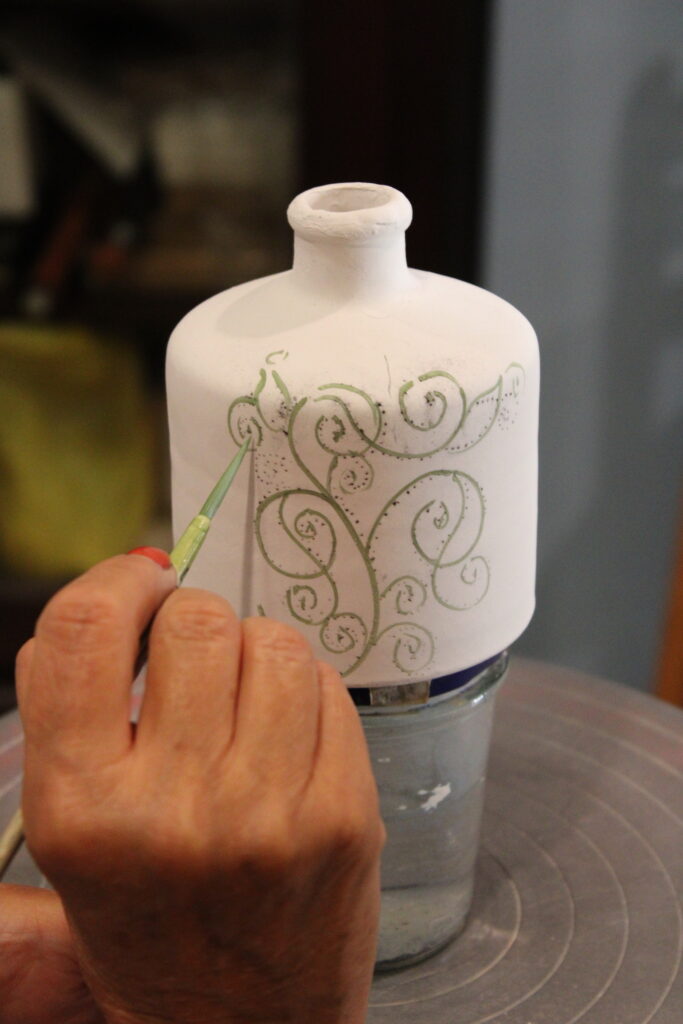
Master ceramicist while creating an artisanal ceramic jar.
The choice of clay: everything starts from the raw material
Every jar is born from the selection of quality clay.
Clay is a natural material composed of minerals that, once processed and fired at high temperatures, acquire resistance, stability, and durability over time.
Even before being modeled, it is carefully kneaded to eliminate any air bubbles and obtain a perfectly homogeneous consistency.
It may seem like a simple step, but it is fundamental.
A correctly prepared mixture reduces the risk of imperfections during firing and allows for uniform and particularly resistant surfaces.
The artisan’s experience is decisive: only those who deeply know the material can evaluate its humidity, plasticity, and consistency.
Turning: when hands give shape to the jar
Among all the phases of processing, turning is certainly the most fascinating.
The clay is positioned on the wheel which rotates slowly while the master ceramicist, with precise and delicate movements, begins to model it.
There are no machines capable of replacing this phase.
Every pressure of the fingers modifies the shape of the artifact, defining its proportions, harmony, and balance.
It is precisely here that the true value of craftsmanship is born.
Every jar possesses its own personality and no piece will ever be perfectly identical to another.
This uniqueness represents one of the reasons why more and more people choose an artisanal jar instead of an industrial container.
Drying: time is part of the process
Once the turning is finished, the work is not yet concluded.
The jar must go through a slow phase of natural drying.
During this period, the moisture present in the clay evaporates gradually, avoiding internal tensions that could cause cracks during firing.
The climate also influences this phase.
The temperature and humidity of the environment can modify drying times, which is why every artifact is constantly checked by the artisan.
In a world where everything is produced rapidly, this process reminds us of the value of time and patience.
The first firing: when clay becomes terracotta
Once drying is complete, the jar enters the kiln.
The first firing generally takes place at temperatures between 950 °C and 1,000 °C.
During this process, the clay is definitively transformed into terracotta, acquiring solidity and structural stability.
This phase also requires great experience.
The kiln follows extremely precise heating and cooling curves: a variation that is too rapid could compromise days of work.
It is one of the steps that most distinguishes an artisanal workshop from industrial production.
Hand decoration: every jar tells a story
After the first firing comes probably the most exciting moment.
The surfaces are decorated manually with thin brushes.
The decorations are often inspired by Mediterranean tradition:
olive leaves;
branches;
floral motifs;
classic geometries;
typical colors of Campanian ceramics.
Every brushstroke is different from the previous one.
Precisely this characteristic makes it impossible to faithfully reproduce two identical jars.
When you buy an artisanal jar, you are not just buying a container.
You are choosing a unique piece, made with time, passion, and expertise.
Glazing: protection and beauty
Once the decoration is finished, the artifact is coated with a glaze suitable for food contact.
The glaze performs several fundamental functions:
it protects the surface;
it makes the container waterproof;
it facilitates cleaning;
it enhances the colors;
it increases brilliance.
In jars intended to contain food, it is essential to use materials that comply with regulations for food contact.
Only in this way is it possible to combine safety, aesthetics, and durability over time.
The second firing
After glazing, the jar faces a second stay in the kiln.
This phase generally takes place between 920 °C and 980 °C.
The glaze fuses perfectly with the ceramic surface, giving the artifact its final appearance.
The colors become more intense.
The surface acquires brilliance.
The entire jar reaches the resistance necessary to accompany the product for many years.
Why is the jar still one of the best containers for extra virgin olive oil today?
A quality extra virgin olive oil is born in the mill, but continues to preserve its characteristics also thanks to correct storage.
For this reason, the choice of container is fundamental.
The ceramic jar offers numerous advantages:
it naturally protects from light;
it maintains a more stable temperature;
it aesthetically enhances the product;
it is reusable;
it represents a prestigious object.
Naturally, it is always advisable to store the jar tightly closed and away from heat sources, so as to best preserve the scents and aromas of our extra virgin olive oil.
Why Contedoro chose ceramics
When we decided to offer our organic extra virgin oil in ceramic jars, we weren’t simply looking for elegant packaging.
We wanted a container capable of telling our philosophy.
Every bottle is born from the work in the olive groves, from the olive harvest, from the milling, and from the care dedicated to every phase of production.
The jar completes this journey.
It is the meeting point between the work of the land and that of the hands.
Between agriculture and craftsmanship.
Between tradition and innovation.
Every Contedoro jar safeguards not only an excellent organic oil, but also the value of artisanal processing that continues to distinguish Made in Italy in the world.
An object destined to last over time
One of the aspects most appreciated by our customers is that the jar continues to live even after the oil is finished.
Many transform it into:
a decorative vase;
a ladle holder;
a furnishing accessory;
a container for dried flowers;
a decorative element for the kitchen.
It is an object that is not thrown away.
It remains in homes as a memory of an experience, of a gift received, or of an important moment.
And it is precisely this ability to combine aesthetics, functionality, and memory that makes every jar much more than a simple container.
Contedoro jars: when craftsmanship meets extra virgin olive oil
There are objects that continue to tell a story even after their use has ended. Contedoro ceramic jars belong to this category.
Once the organic extra virgin olive oil is finished, the jar does not lose its value. On the contrary, it transforms into a furnishing accessory, a decorative object, or a memory linked to a special moment.
It is precisely this double soul, aesthetic and functional, that makes it an increasingly appreciated choice by those who love Made in Italy, craftsmanship, and authentic products.
For us at Contedoro, every jar is born to safeguard a high-quality extra virgin olive oil, but continues its story even after arriving on the table.
Collection of Contedoro ceramic jars.
Discover the Contedoro jar collection
Every jar tells a different symbol of Italian tradition.
We have created a collection that combines art, territory, and culture, with hand-made decorations that transform every piece into a small masterpiece.
You can discover the entire collection in the category dedicated to ceramic jars for oil.
Tree of Life Jar
The Tree of Life Jar represents one of the most important symbols of Mediterranean culture.
The tree has always been synonymous with growth, strength, balance, and continuity between generations.
It is a very appreciated choice both as a gift and as a furnishing accessory, capable of safeguarding an excellent organic extra virgin oil and subsequently becoming a refined decorative element.
Olive Jar
The Olive Jar directly recalls the world of olive growing.
The decorations inspired by branches and olives represent the link with the olive groves and with the production of our extra virgin olive oil.
It is the ideal model for those who wish to bring to the table an object that immediately tells the culture of EVO oil.
Wheat Ear Jar
The Wheat Ear Jar celebrates one of the oldest symbols of Italian agriculture.
The wheat ear represents abundance, fertility, and prosperity, values deeply linked to peasant tradition.
For this reason, it is particularly appreciated as an elegant gift or as a decorative object for the kitchen.
A gift idea that combines taste and craftsmanship
In recent years, ceramic jars have become one of the most appreciated gift ideas.
Unlike a simple decorative object, they embody two Italian excellences:
In a world where many products are mass-produced, choosing an artisanal ceramic jar means valuing the work of people, the territory, and Italian tradition.
For us at Contedoro, the jar is not just a container.
It is the symbol of the same attention that we dedicate every day to our olive groves, to the production of our organic extra virgin oil, and to the search for quality in every detail.
From the hand-modeled clay to the oil safeguarded inside, every jar tells a story made of passion, authenticity, and respect for Made in Italy.
Technician and expert in extra virgin olive oils, registered in the National Register, Campania section. Master oil miller with diploma, obtained from International Extravirgin Agency.
Manage Consent
To provide the best experiences, we use technologies like cookies to store and/or access device information. Consenting to these technologies will allow us to process data such as browsing behavior or unique IDs on this site. Not consenting or withdrawing consent may adversely affect certain features and functions.
Functional
Always active
Technical storage or access is strictly necessary for the legitimate purpose of enabling the use of a specific service explicitly requested by the subscriber or user, or for the sole purpose of carrying out the transmission of a communication over an electronic communications network.
Preferences
Technical storage or access is necessary for the legitimate purpose of storing preferences that are not requested by the subscriber or user.
Statistics
Technical storage or access that is used exclusively for statistical purposes.Technical storage or access that is used exclusively for anonymous statistical purposes. Without a subpoena, voluntary compliance on the part of your Internet Service Provider, or additional records from a third party, information stored or retrieved for this purpose alone cannot usually be used to identify you.
Marketing
Technical storage or access is required to create user profiles to send advertising, or to track the user on a website or across several websites for similar marketing purposes.