
Have you ever had to choose between a filtered oil or unfiltered oil?
Even on supermarket shelves, it is now common to find bottles with the words “unfiltered oil” on the label. But what does it mean, and what is the difference between filtered and unfiltered oil? Why should you choose one over the other?
Well, with this article we want to provide you with all the necessary information to help you make a conscious choice between a filtered oil or an unfiltered oil, discover if one is better than the other, and define what is best for your specific use.
Let us start, then, by describing unfiltered oil.
On supermarket shelves, it seems that unfiltered oil is better than filtered oil, because it is marketed as 100% natural oil or more premium. But is that so? Is an unfiltered oil truly better than a filtered oil?
Unfiltered oil, as the name suggests, does not undergo the filtration process, resulting in an oil that appears cloudier, with a more intense flavor and a more fragrant aroma. Unfiltered oil contains those small olive particles (pit and pulp) and water that would be removed by filtration. It is therefore a raw oil, with a darker and cloudier color.
Over time, the particles present tend to settle at the bottom of the bottle and, to prevent them from rotting, it is best to transfer the oil into a clean bottle to separate the oil from the sediment deposited at the bottom.
There are advantages and disadvantages to choosing an unfiltered oil. Let’s look at them.
Now let’s define filtered oil.
Read also: EVO Oil: What It Is and Meaning of the Acronym
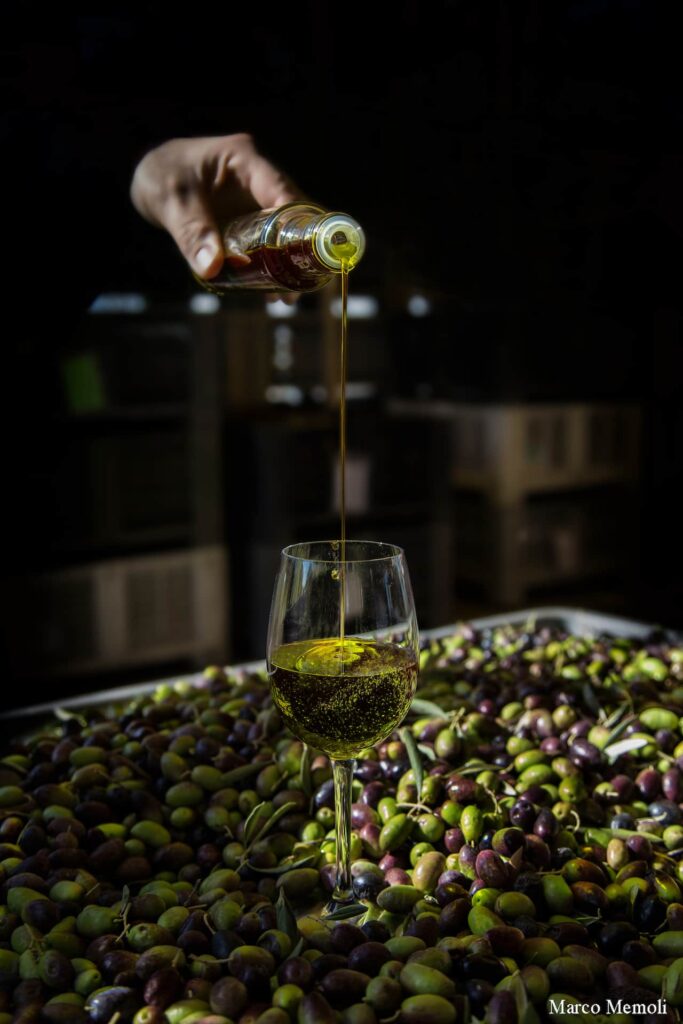
Filtered extra virgin olive oil has its advantages because the filtration process makes the oil more stable and longer-lasting. Oil, in addition to fearing light and air, is not a friend of water. The combination of light and oxygen can modify the product and degrade its quality, making it rancid. Water, on the other hand, can ruin its composition and organoleptic characteristics, significantly shortening its shelf life. Thanks to filtration, however, the vegetation water contained in the raw oil is eliminated and does not risk ruining the oil. Filtered oil has a clearer appearance precisely because it is free of pulp, pit, and water particles, which are completely filtered and removed.
In summary, we can say that filtered EVO oil:
Oil treatment today is mostly carried out with centrifugal machinery that allows the separation of pomace (solid part) and water from the oil. Specifically, filtration today occurs through the use of filters with fossil flours and virgin cellulose which, layered on a filter to form the filtering barrier, are passed through by the oil, retaining water droplets and solid residues, in order to obtain a pure and brilliant oil.
With filtering, the oil does not lose its organoleptic qualities and chemical characteristics but acquires greater stability, allowing it to be used over a longer period of time.
But, ultimately, why is it important to filter oil?
As you can guess from what we have seen so far, filtered oil has the great advantage of being longer-lasting. Olive oil that has been filtered is purified of water particles and olive and pit residues. It therefore does not generate sediment in the bottle and does not risk becoming rancid. It lasts much longer and it is not necessary to decant it into a clean bottle, because it is already clean, limpid, and clear.
Although they want to sell us raw unfiltered oil on the shelves as better, it is not necessarily so. The quality of the oil is not determined by the filtering process but by the quality of the raw materials used, namely the olives.
Read also >> How to recognize Italian extra virgin olive oil
As we mentioned above, the quality of the oil is determined by the type of olives crushed. A premium oil is premium regardless of the filtration process. The choice, at this point, is personal, depending on one’s own taste.
If you choose a raw oil, unfiltered, know that it must be consumed in a short time (2 or 3 months from pressing and bottling). Furthermore, when pulp and pit residues settle at the bottom, it is better to decant the oil into another bottle, strictly a dark one.
Ultimately, if you are a frequent consumer of oil, you can choose unfiltered oil. You will likely have time to consume it in one or two months.
If, on the other hand, you use little oil, it is better to choose a filtered olive oil, so that it does not spoil over time and can remain stable for longer.
However, we can suggest a further alternative:
For those who do not want to choose, another option is to use raw oil in the first period after pressing (in the autumn-winter period) and continue with filtered oil in the following period, so that storage problems are eliminated and you can always use a quality oil.
Speaking of preservation, we want to conclude this article by telling you that at Contedoro we have launched a new idea for favors. A jar with oil for wedding favors, not only the perfect gift for ceremony guests, but also useful as it is then possible to store oil inside it, whether filtered or unfiltered.